
Design has always evolved. Print gave way to digital. Desktop gave way to mobile. Each shift redefined what a designer actually does, which tools they reach for, and what value they’re expected to bring.
AI is not just another one of those shifts. It’s a restructuring of the creative process itself and it’s changing not just how designers work, but how their work gets judged.
I’ve spent years designing products across AI automation tools, Web3 platforms, healthcare technology, and enterprise SaaS, the kind of work you can see laid out in my case studies. What I’m watching happen right now isn’t a threat to designers. It’s the most exciting opening our field has had in a long time. But it asks something new of us on two fronts: how we work, and what we’re actually optimizing for. Let’s get into both.
What the Job Used to Mean
For most of design’s history, the work was about craft: hierarchy, color, typography, layout. A strong designer was judged by how polished and intuitive their output looked.
Then UX entered the picture and moved the goalpost from aesthetics to behavior. Designers had to start understanding people, not just pixels research, journey mapping, and usability testing became essential skills.
We’re now entering a third era, and it’s a bigger leap than the last one.
How AI Is Actually Changing the Process
AI isn’t replacing designers. It’s replacing the pieces of the job that never really needed a human doing them in the first place.
Generating variations, resizing assets, drafting placeholder copy, running a first-pass accessibility check AI now handles all of that. Tools like Claude, Claude Code, Figma AI, and Midjourney can turn a text prompt into wireframes, UI components, even production-ready code.
According to McKinsey’s 2024 State of AI report, generative AI could automate up to 30% of tasks in design-adjacent roles by 2030. But that same report is clear that creative synthesis, stakeholder communication, and systems thinking remain highly resistant to automation.
So what does this actually mean? The commodity part of the job is being automated. The strategic part is becoming more valuable than it’s ever been. AI doesn’t replace designers it replaces the AI product designer who refuses to evolve alongside it.
What’s Actually Shifting in the Day-to-Day Work
Having worked on AI products like Propchain, RevelAI Health (conversational AI for care coordination), an internal AI knowledge base serving 2,600+ users, and Spheron Network’s AI-agent compute marketplace, I’ve watched this shift happen firsthand.
Here’s what’s moving:
From visual output to systems thinking. Designers aren’t just producing screens anymore they’re designing entire interaction systems, including how the AI responds, where it breaks down, and how a person recovers when it does.
From static flows to adaptive experiences. AI products don’t move through a fixed, linear journey. The interface shifts based on what the AI currently knows, which means designing around probabilistic behavior and dynamic state, not a predictable path.
From pixel-pushing to prompt engineering. Working with AI-generated assets means being able to prompt effectively, evaluate output critically, and get it integrated into a production-ready system.
From solo execution to cross-functional orchestration. On AI-first teams, designers sit between ML engineers, data scientists, product managers, and ethicists. Translating across those groups now matters as much as craft does.
What the Market Expects From Senior Designers in 2026
Working with founders, CTOs, and product teams at startups and enterprises worldwide as part of my work as a top-3% Toptal talent has made the new baseline pretty clear:
- AI literacy, not just AI awareness. You don’t need to write model code, but you need to understand how LLMs behave, how computer vision reads an interface, and what “hallucination” means for a product built around AI responses.
- Designing for trust and uncertainty. AI makes mistakes. Error states, confidence indicators, and human-in-the-loop recovery paths are now core design work especially for a healthcare UX designer or anyone building in fintech.
- Design systems that hold up at scale. AI-powered products ship fast. Without tokens, variables, and real component logic, the design becomes the bottleneck. The expectation now is systems, not isolated screens.
- Outcome orientation. Founders don’t want a beautiful Figma file. They want retention up, churn down, onboarding faster designers who can tie decisions to a business metric are the ones who don’t get replaced.
- Ethical judgment. Who’s accountable when an AI recommendation is biased? Where does personalization cross into manipulation? Designers are increasingly expected to hold that line.
Nielsen Norman Group’s 2024 AI UX research names the biggest skill gaps in designers working on AI products as: designing for non-deterministic output, communicating AI limitations to users, and building real feedback loops into the interface.
The best designers I’ve worked alongside never just made things look good they made complex systems feel simple. In the AI era, that’s not a bonus skill. That’s the whole job. And it leads directly to the second half of what’s changing: not just how designers work, but what they’re expected to prove once the work ships.
You Shipped a Beautiful Screen. Nobody Cared.
That sounds harsh, but it’s the quiet reality reshaping design careers right now. One idea sits underneath everything above: founders don’t want beautiful Figma files, they want measurable outcomes. That’s the mindset shift that decides whether any of the skills above actually matter for your career.
The Trap of “Just the Screen”
For most of design’s modern history, the deliverable was the screen. Success meant a polished flow, a clean handoff, something worth screenshotting for Dribbble. Nobody really asked what happened after the screen shipped, because “after” belonged to someone else a PM, a growth team, an analyst.
That division of labor is exactly what’s collapsing now. When AI can produce a competent screen from a prompt in seconds, the screen stops being the scarce resource. What’s scarce now is knowing which screen, for which user, solving which problem, moving which number. If all you can do is produce the artifact, you’re competing with a tool that does it faster and cheaper than you ever could. If you can explain why the artifact should exist at all, you’re not competing with it you’re the reason it exists.
Output vs. Outcome
Outputs create products. Outcomes create businesses.
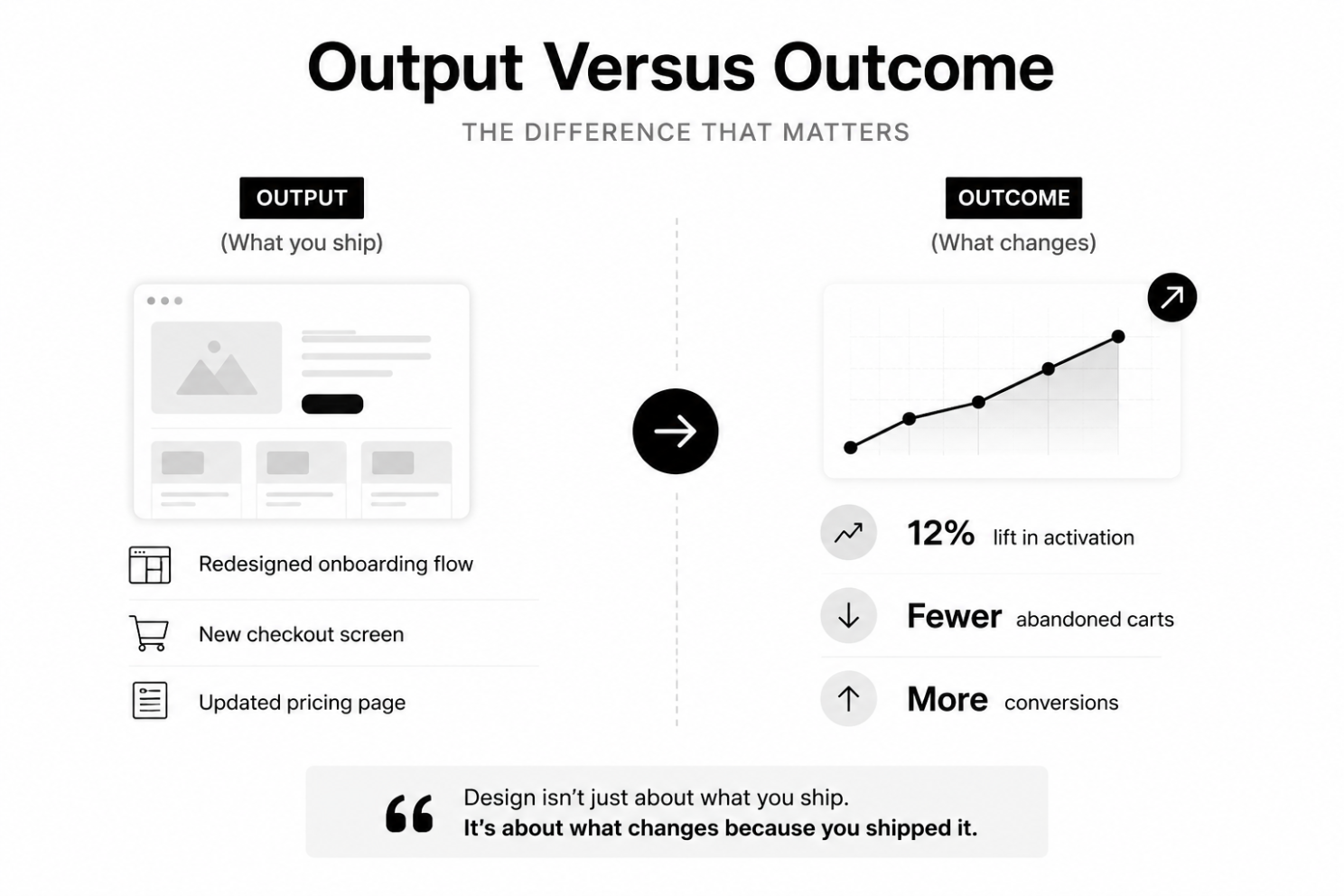
An output is what you shipped. An outcome is what changed because you shipped it. Redesign the onboarding flow that’s an output. Activation climbs 12%. That’s an outcome. Ship a new checkout screen output. Cart abandonment drops outcome.
Put that way, it sounds obvious. But it’s rarely how design work actually gets talked about day to day. Most critique sessions, portfolio reviews, and Slack updates are still stuck in output-language: “here’s what I made,” instead of “here’s what it did.”
Here’s the uncomfortable part: outcomes are genuinely harder to control than outputs. You can promise a screen ship by Friday. You can’t promise a metric move. But that’s exactly why designers practicing outcome-driven design are becoming more valuable, not less. Anyone can hand over a deliverable. Putting your name on a result means you actually had to understand the problem behind the request.
This isn’t just a nice philosophy, the numbers back it up. McKinsey’s long-running research on design performance found the differentiator for top-performing companies wasn’t more screens shipped. It was treating design as a measurable driver of business performance, not a visual finishing step. Top-quartile companies on McKinsey’s Design Index grew revenue 32 percentage points faster than industry peers over five years, with total shareholder returns growing 56 points faster.
Redesigning How You Work, Not Just What You Make
Making this shift isn’t about learning a new tool or adding “data-driven” to your bio. It comes down to a handful of concrete habits:
Ask what’s supposed to change before you open Figma. Before any project starts, get a straight answer on which business or user metric you’re trying to move, and how you’ll know if it worked. If nobody can answer that, that’s your real first design problem.
Attach a number to the brief. Not a vague goal like “improve the experience,” but something specific reducing time-to-first-value, say, or lifting week-two retention. Vague goals just produce beautiful work nobody can be held accountable for.
Stay attached after launch. Ownership doesn’t end at handoff. Check the dashboard two weeks later. If the number didn’t move, don’t hide from it that’s probably the most useful design data you’ll get all quarter.
Translate your work into the language of the business. When you present, lead with the outcome, not the craft. “This reduced onboarding drop-off” lands with a founder in a way “I used a card-based layout” never will. This is exactly the approach behind the work in my case studies.
A New Definition of “Done”
For years, “done” meant shipped. In an outcome-driven practice, “done” means proven. That’s a harder bar to clear and honestly, it should be. It’s the bar that separates designers a generative tool can easily replace from designers a business can’t afford to lose.
This Is an Opening, Not a Threat
I’ll say it plainly: this is a genuinely good time to be a designer.
The cost of shipping a product has dropped fast. Founders validate ideas quicker. Teams run leaner. In that environment, a designer who thinks strategically, executes efficiently, and can point to a result isn’t just useful, they’re a multiplier for everyone around them.
The designers who struggle from here will be the ones still measuring their worth in screens produced. The ones who thrive will measure it in clarity of thinking, quality of communication, and proof that their decisions moved a number that mattered.
From my own time at Toptal, inside the top 3% of design talent globally, demand for designers with real AI-product experience has roughly tripled over the last 18 months, a trend that lines up with the World Economic Forum’s Future of Jobs Report 2025. Companies aren’t just hiring for craft anymore. They’re hiring for a strategic partner who can prove it worked.
Where to Start
If you’re a designer reading this, here’s the practical version:
- Put AI tools into your workflow now not to think for you, but to amplify your thinking. Claude for design reasoning, Claude Code for rapid prototyping, Figma AI for component generation, Midjourney for mood boards. Aim for fluency, not dependency.
- Design an AI product, even as a side project. Designing for non-deterministic output, trust cues, and error states will change how you approach every product after it.
- Attach a number to every brief. Not “improve the experience” something specific, like time-to-first-value or week-two retention.
- Stay attached after launch. Check the dashboard two weeks later. Whether the number moved or not, that’s the most useful data you’ll get all quarter.
- Get closer to the business. Learn retention, conversion, and activation numbers. Decisions backed by data speak the same language as every CEO and investor in the room.
- Build in public. Share your thinking and your process, not just your polished shots. AI can generate a portfolio. It can’t generate your judgment or your track record.
AI isn’t lowering the ceiling for designers. It’s raising the floor for what counts as baseline craft and raising the bar for what “done” means. The screen was never the point. It was always just the vehicle. The era of the pixel-perfect designer is over. The era of the systems-thinking, AI-fluent, outcome-driven design practitioner is just getting started and honestly, it’s a great time to be in this field.
If you want to see how this plays out on a real project, my case studies walk through it, or you can read more about how I work on the about page.